COMPETITIVE BENCHMARKING & FIELD RESEARCH
The Anti-Panopticon Paradigm:
Field Discoveries & Competitive Audits
Rigorous competitive analysis and field studies demonstrating why current community safety tools fail, and how Civic Radar establishes an open, battery-free, privacy-first civic mesh.
The Flaws of Surveillance Capitalism in Public Safety
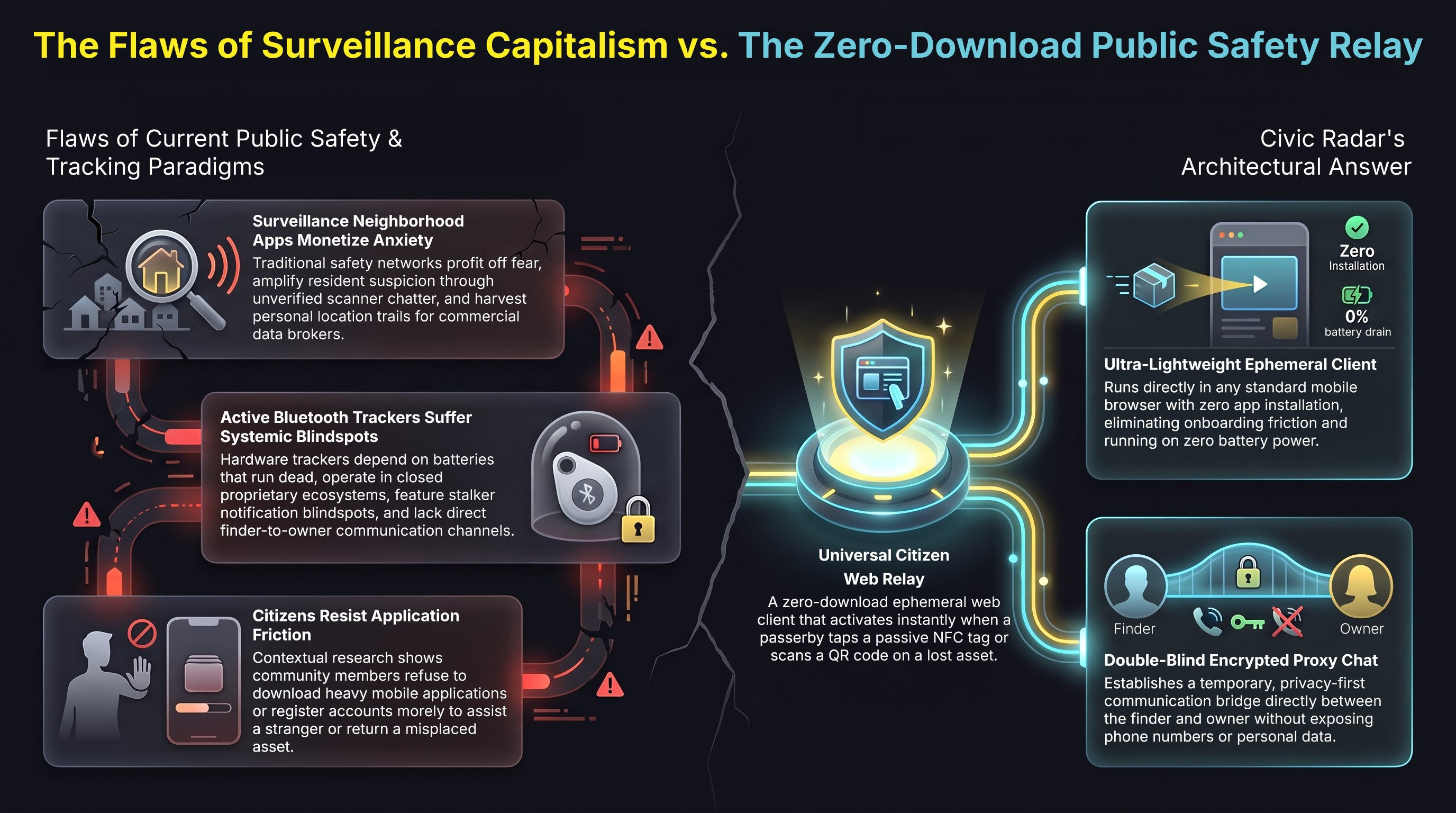
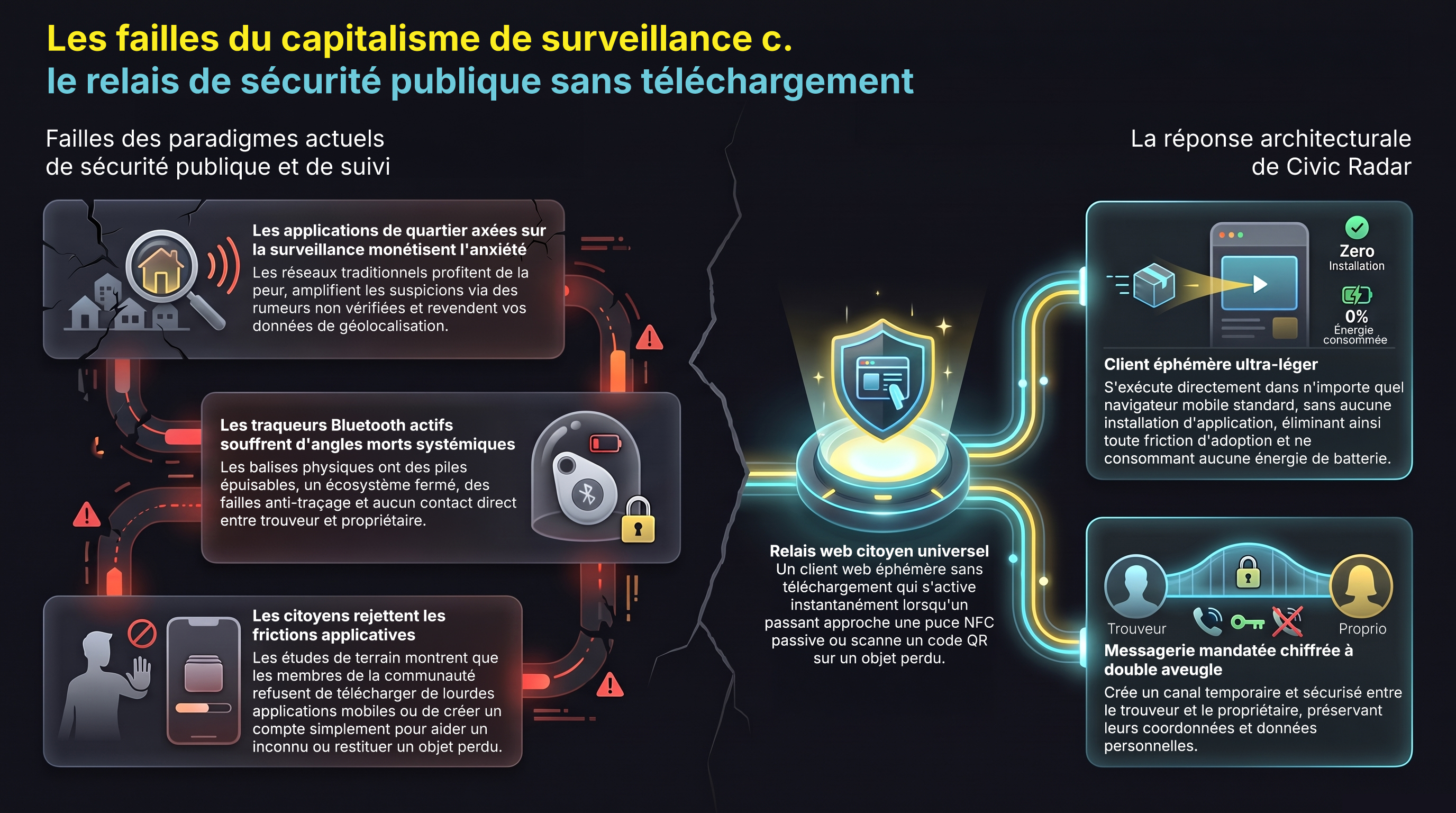
Existing digital public safety and asset recovery solutions are divided between two deeply flawed paradigms: surveillance-driven neighborhood apps that monetize anxiety, amplify resident suspicion through unverified scanner chatter, and sell location trails to commercial data brokers, and proprietary Bluetooth tracker ecosystems (Apple AirTags, Tile, Samsung SmartTag) that suffer from dead batteries, stalker notification blindspots, and a total lack of direct communication channels between finder and owner.
Civic Radar's contextual research reveals that community members (Citizens) actively resist downloading bloated mobile applications simply to assist a stranger or return a lost item (Vault Asset). Our architectural answer is the zero-download web interface (Universal Citizen Web Relay)—a lightweight (<120KB) ephemeral browser client triggered via passive NFC or QR scan that connects finders directly to owners over double-blind encrypted proxy chat with zero app installation required.
Direct Head-to-Head Architectural Comparison
How Civic Radar thoughtfully expands beyond legacy models across critical community dimensions:
Standard Bluetooth tags rely on ongoing battery maintenance, proprietary app ecosystems, and individual coverage networks. Civic Radar physical tags (Asset Tags) are battery-free, accessible across all modern smartphones via open Web NFC/QR standards, and designed for immediate, zero-friction community utility.
Unstructured public feeds can unintentionally amplify anxiety and noise in a community. Civic Radar replaces unverified commentary and public scoreboards with structured, calm consensus verification (Info, Advisory, Emergency) to foster quiet confidence and genuine trust.
High-volume incident reporting can create ticket duplication and strain municipal response times. Civic Radar autonomously unifies duplicate neighborhood updates and routes verified, actionable data smoothly to support local emergency managers (Guardians).
Cash incentives for lost items can sometimes invite friction or opportunistic behavior. Civic Radar focuses on community care, encouraging mutual assistance through gentle recognition points redeemable for special discounts at local verified merchants (Beacons).
ZERO APP DOWNLOADS
Good Samaritans assist instantly via sub-120KB ephemeral web relays without account barriers, making community help frictionless and immediate.
BATTERY-FREE HARDWARE
Passive NTAG213 anchors cost cents, last indefinitely, and require zero proprietary ecosystem silos, ensuring long-term hardware reliability.
RADICAL DATA PRIVACY
Designed around Quebec's Law 25: zero continuous GPS logging, with 300m residential fuzzing to keep homes and movements private.
SAFE HAVEN ESCROW
Merchant drop-boxes provide secure Dual-PIN handoffs, eliminating risky peer-to-peer meetups while grounding recoveries in trusted neighborhood spots.
Audio overview transcript
This is the Brief on the Flaws of Surveillance Capitalism in Public Safety. Right now, our digital recovery tools are totally broken. They either monetize our anxiety and sell our location data, or they rely on dead batteries. But a new system called Civic Radar actually proves we can protect our belongings without sacrificing privacy or downloading bloated apps. Proprietary Bluetooth trackers are kind of like a flashlight that always dies right when you need it. Civic Radar instead uses battery-free physical tags accessed via open web near-field communication or quick response codes. They're like a permanent mirror, simply reflecting information when scanned. Anyone can scan a tag to instantly open a private chat. Zero app downloads required. Plus, it strictly follows the General Data Protection Regulation and Quebec Law 25, meaning absolutely zero background global positioning system tracking.
Second, the physical handoff. So how do you get your item back without an awkward stranger meetup? Well, local trusted merchants act as secure drop-off points. You simply retrieve your stuff using a quick code verification, completely replacing stressful social media blasts with calm consensus. But wait, why would a stranger bother to walk your lost item to a store?
Finally, the community impact. Instead of cash bounties that can invite bad behavior, the system rewards finders with discounts at those local merchants. Because, you know, it's nice to be kind. It also autonomously unifies duplicate reports, routing verified data to emergency managers so we don't strain municipal dispatch.
Ultimately, the future of community safety relies on passive technology and mutual trust, not constant surveillance.