GOVERNANCE, COVENANT & ACTOR INTEGRATION
Coordinating Kindness, Elevating Care:
Join the Civic Radar Mesh
Dedicated onboarding pathways for everyday residents, local merchants, emergency coordinators, and municipal stakeholders in the Montreal pilot. Civic safety is not a product we buy; it is a covenant we build together through mutual respect, shared accountability, and radical empathy.
The Four Onboarding Gateways: Tailored Engagement Pathways
Whether you are an active neighbor wanting to protect your belongings, an independent cafe owner offering safe shelter, or a city official modernizing non-emergency dispatch, Civic Radar provides dedicated, zero-friction integration tracks.
Our Montreal core team will work directly with community groups and municipal agencies to ensure compliant hardware rollouts, verified Beacon onboarding, and ethical Duty of Care governance.
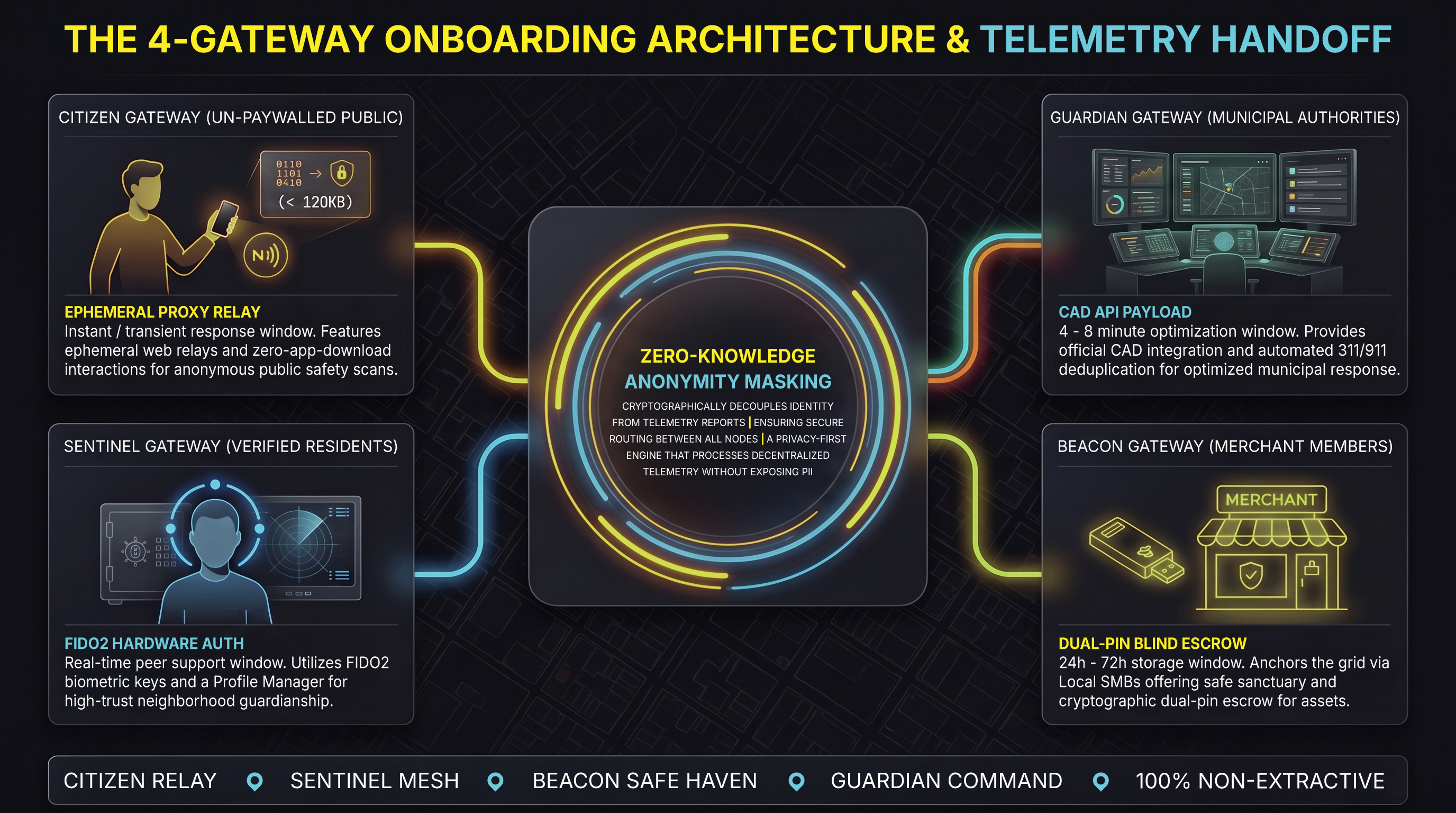
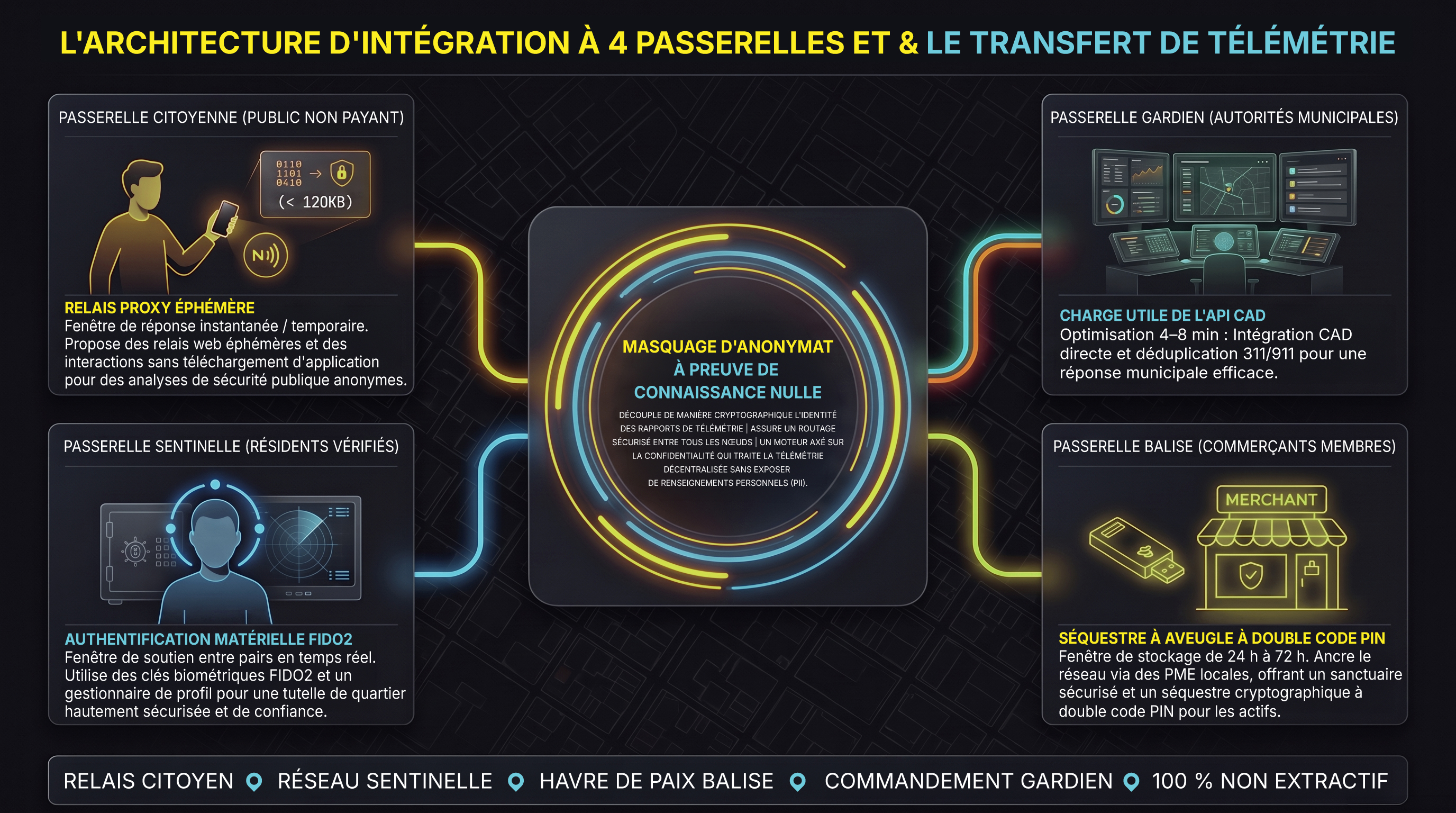
Zero-download mobile web interface (for everyday non-members)
Scan any physical tag instantly using a mobile browser to return lost items, contact owners anonymously, or locate nearby community support.
Verified active community members (everyday neighborhood residents)
Order residential asset tag kits (physical home docks), manage encrypted personal asset registries, and participate in local mutual assistance.
Verified local business partners (community sanctuary spots)
Serve as secure, private drop-off locations for lost items, providing temporary storage and refuge without handling private user data.
Municipal safety and dispatch authorities (city operators and transit)
Access clean, deduplicated CAD (Computer-Aided Dispatch) feeds to monitor localized street events, reduce non-emergency call volume, and coordinate official response.
Citizens, Sentinels and Beacons all connect to the Civic Radar core, which passes clean dispatch feeds on to the Guardian (the city).
B2G Municipal & Institutional Integration: The Montreal Proving Ground
Municipal & Institutional Vision
Civic Radar is designed to collaborate directly with municipal borough councils, transit authorities (such as the STM and REM), and local emergency services to modernize city-wide lost property processing and reduce non-emergency pre-triage noise.
Automated CAD & Triage Architecture
Upon funding and deployment, the platform will utilize standard CAD (Computer-Aided Dispatch) ingestion adapters and automated geofenced deduplication. This planned infrastructure will allow public agencies to reduce 311 intake volume, prevent duplicate dispatch calls, and ensure recovered belongings are returned safely without exposing citizen contact details.
-
1.
Municipal 311 Offloading Plan
Our operational rollout strategy directs minor property losses to automated peer-to-peer routing and Safe Haven (verified local business drop-off sanctuaries) escrow resolutions before calls reach city dispatch centers. -
2.
Commercial Safe Haven Corridors
The launch roadmap includes turnkey onboarding kits tailored for local Business Improvement Areas (BIAs) and merchant associations across primary pilot corridors. -
3.
Direct Pilot & Partnership Inquiries
We invite municipal partners, transit stakeholders, and early-stage investors to review our architectural documentation, request hardware sample kits, and explore institutional pilot demonstrations.
The Open Civic Covenant: Statutory Duty of Care & Non-Extractive Design
Our Core Ethical Commitment
Civic Radar is built on an uncompromised ethical covenant: technology exists to serve human dignity, support neighborly aid, and foster mutual care—not to capture or commodify human attention. Our foundational charter establishes four permanent operating principles:
-
•
Rejection of Algorithmic Fear
Zero sensationalized crime feeds, mob tracking features, or unverified public doxxing channels. The platform prioritizes de-escalation, clear context, and calm, structured communication over panic-driven notifications. -
•
Data Minimization by Default
Zero persistent telemetry collection, zero location tracking in dormant states, and zero third-party advertising data brokers. Spatial intelligence is anchored strictly to physical passive tags rather than tracking human movement. -
•
Right to Absolute Erasure
A simple, complete account liquidation process that permanently purges user records, unlinks associated asset tags, and removes local metadata traces instantly—ensuring full citizen agency over personal data. -
•
Community-Governed Reinvestment
Local public safety grants are directed transparently through collaboration between verified Sentinels and local Non-Profit Organizations (NPOs), ensuring platform success directly funds visible neighborhood improvements.
Connect With the Core Mesh: Montreal Pilot Team & Inquiries
We welcome inquiries from community organizers, cycling advocacy groups, independent business associations, municipal emergency planners, and civic technology researchers.
Plateau-Mont-Royal & Mile End Innovation District, Montreal, Quebec, Canada.
Inquiries and pilot coordination: frederic.robert.parenteau@gmail.com
CIVIC COVENANT
A shared community commitment to empathy, mutual dignity, and proactive care.
4-ACTOR ONBOARDING
Custom integration pathways for Citizens, Sentinels, Beacons, and Guardians.
MONTREAL ROOTS
Grounded in local Montreal street-level urban experience and community spirit.
OPEN AUDITING
Transparent retrospective reviews ensuring persistent adherence to the Duty of Care.
Audio overview transcript
This is the brief on the planned governance and integration of Civic Radar. You know, this future platform frames neighborhood safety as a shared human covenant. Permanently rejecting algorithmic fear, panic monetization, and mob tracking for radical empathy and human dignity.
First, they're planning four onboarding gateways. It's kind of like a symphony where everyone plays a specific instrument from the same sheet music of community care. Passers-by will just use a zero-download mobile web tool to find lost property or safe Refuge. Residents can coordinate mutual aid using secure home hardware and private access keys. Local merchants are going to display storefront decals offering secure drop-offs and physical safety. And municipal Guardians like the Société des Transports de Montréal, the Réseau express métropolitain, and Borough Councils will connect directly using 911 computer-aided dispatch adapters to cut through the noise.
Second, a planned live pilot across Montreal's Plateau–Mont-Royal and Mile End districts features a totally non-extractive economic engine. A 15% civic dividend from platform revenue will directly fund community-voted safety projects. Honestly, how rare is it for a tech platform to literally fund the physical streets it operates on?
Finally, all of this requires absolutely strict privacy. Adhering to Quebec Law 25 and the General Data Protection Regulation, the plan guarantees zero persistent background global positioning system tracking, Canadian data hosting, and one-click account erasure. I absolutely love this. They're planning automated 72-hour session data evaporation, a brilliant contrast to traditional data hoarding. Active contact gateways are completely open for inquiries from civic technology researchers, merchants, and merchant associations, cycling advocacy groups, and municipal emergency planners.
Ultimately, Civic Radar's planned architecture proves that urban security really can prioritize mutual aid, human dignity, and strict privacy without ever sacrificing efficiency.