SUSTAINABILITY & MUNICIPAL IMPACT
Prosocial Sustainability:
A Self-Sustaining Model for Community Safety
Civic Radar operates as a self-sustaining public utility. By combining durable passive hardware, flexible municipal software licensing, and local business partnerships, the platform funds its own operations without relying on extractive ad networks or selling user data.
The Tri-Partite Monetization Engine: Hardware Margins, Municipal SaaS & Merchant Halo
Civic Radar rejects the model of running deep operating losses funded by user surveillance. Instead, the platform relies on three synchronized, cash-flow-positive revenue streams designed to scale organically alongside urban density.
1. Direct-to-Consumer Physical Hardware
Our passive, battery-free NFC anchor tags (Asset Tags) and decal packs generate strong, immediate cash flow upon customer acquisition with targeted 70%+ gross margins. These low-cost, durable hardware bundles serve as accessible entry points for community members (Citizens) protecting everyday personal belongings (Vault Assets).
2. Guardian Municipal SaaS Subscriptions
We partner with local governments through flexible annual software licensing tiers tailored to city size and dispatch needs. These contracts unlock automated 311 report deduplication, pre-siren neighborhood triage, and early-warning telemetry for emergency dispatch centers and transit authorities.
3. Beacon Commercial Verification:
Local independent businesses subscribe to join the network as verified neighborhood beacons (Beacons) and drop-off sanctuary (Safe Haven) escrow hubs. Participating merchants benefit from discounted membership options when committing to drop-off sanctuary (Safe Haven) standards, converting community asset drop-offs into steady, high-intent customer foot traffic.
Note: Financial projections, pricing tiers, and margin targets are current directional estimates intended to illustrate the business model structure, and will be finalized upon completion of our formal financial audit.
Municipal Dispatch Offloading: Reducing Non-Emergency Costs
Municipal 911 and 311 switchboards are routinely congested with low-urgency incidents—such as lost bicycles, missing keys, lost pets, and minor neighborhood disputes. Processing these non-emergency calls places a heavy financial and operational strain on public safety resources, driving up labor, fuel, and administrative overhead for local governments.
Civic Radar's decentralized peer recovery loop and local merchant network (Beacon Safe Haven network) resolve a significant portion of routine localized incidents at the community level, preventing unnecessary municipal dispatch calls.
By transferring routine custody handoffs to local merchant partners (Beacons) and enabling direct, double-blind peer communication over our privacy proxy layer (Privacy Bridge), city emergency services free up critical capacity to focus on urgent, life-safety emergencies.
Note: Dispatch offloading models and cost-reduction estimates represent current operational projections. Detailed financial and workload impact metrics will be updated following our complete municipal dispatch analysis.
Hardware Architecture: Passive 6-Layer Composite
Battery-Free Restoration Traditional consumer trackers rely on active Bluetooth modems, coin-cell batteries, and persistent cloud polling. Because these active devices require frequent charging and battery replacements, they risk going dark right when you need them most. Civic Radar replaces active electronics with passive, battery-free physical identifiers (Asset Tags) that stay active indefinitely without ongoing maintenance.
Multi-Layer Composite
Construction Civic Radar manufactures ultra-thin NFC (Near Field Communication) and high-contrast QR code tags built with a protective UV-stable outer barrier and high-tack adhesive. Designed for all-weather durability, these tags feature a micro-thin ferrite isolation layer, allowing them to perform seamlessly on any surface—including metallic bike frames, electronics, and municipal equipment—without signal interference.
Frictionless Community
Ecosystem Scanning a tag or tapping an NFC physical recovery marker (The Anchor) instantly opens a secure, encrypted communication channel between the finder (Citizen) and the owner over our double-blind proxy chat (Privacy Bridge). Because passive tags require zero cloud polling, zero battery replacement, and zero SIM connectivity, they eliminate ongoing maintenance costs while enabling instant neighborhood mobilization through the interactive spatial map interface (The Sweep).
Operational Scale & Infrastructure: Lean Deployment Architecture
Operational Alignment & Data Governance: Civic Radar scales through lean, disciplined engineering rather than administrative bloat. The operational model prioritizes autonomous cloud infrastructure, localized merchant onboarding, and privacy by design—built around regional privacy laws such as Quebec's Law 25.
-
1.
Core Engineering & Technical Operations
The core technical pod focuses on maintainable, reliable infrastructure, including systems architecture, telemetry engineering, mobile PWA interfaces (Universal Citizen Web Relay), and CAD (Computer-Aided Dispatch) municipal gateways. By automating core server workloads, the engineering stack maintains 99.99% system uptime SLA (Service Level Agreement) with automated horizontal scaling while keeping fixed operational overhead exceptionally low. -
2.
Civic Field Coordination & Safe Haven Onboarding
Dedicated local liaisons lead hyper-local community coordination, managing merchant verification for drop-off sanctuaries (Safe Havens—verified local business sanctuaries for emergency aid and item returns). These liaisons lead dispatch training workshops and organize neighborhood outreach across target pilot corridors to ensure seamless physical-to-digital coordination. -
3.
Sustainable Capital & Pilot Runway
By pairing efficient server overhead with low-cost passive hardware (Asset Tags), Civic Radar extends its pilot runway without forcing early dilutive fundraising or extractive user monetization. The platform maintains a self-sustaining utility model that supports growth while keeping core safety tools free and accessible to everyday citizens (Citizens).
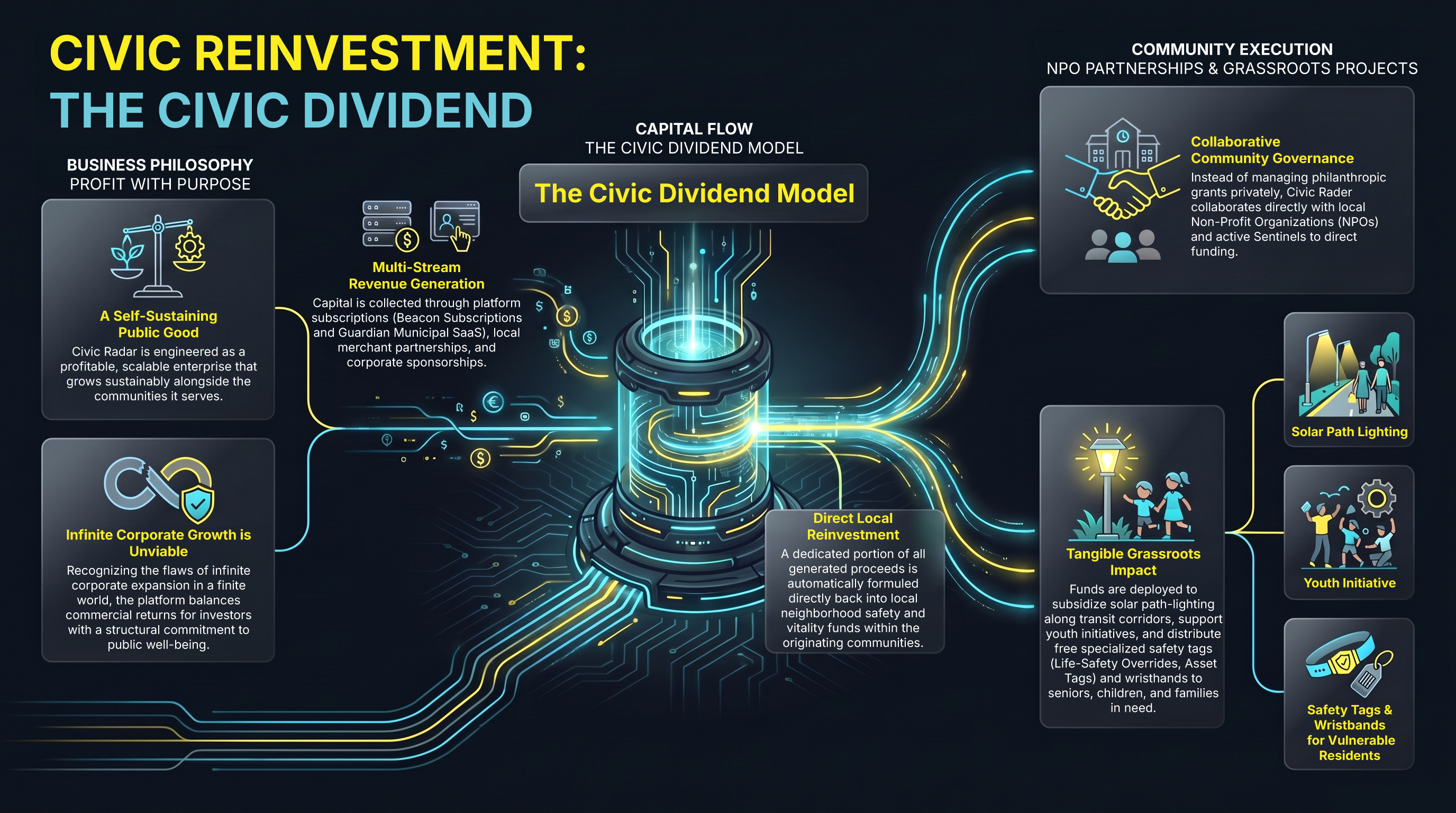
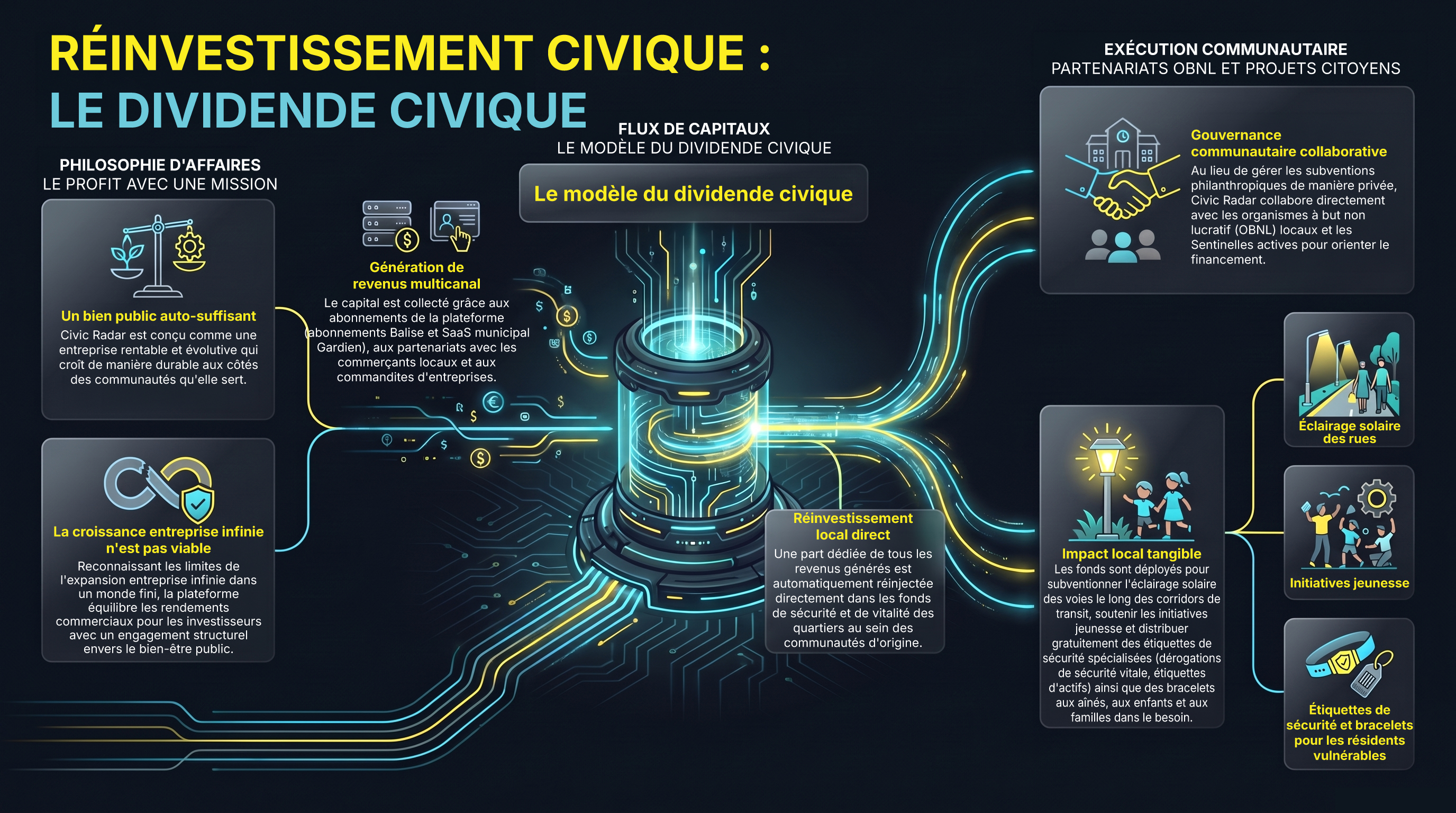
The Civic Dividend: Profit with Purpose
A Self-Sustaining Public Good: Civic Radar is designed to be a profitable, scalable business that grows sustainably alongside the communities it serves. Recognizing that infinite corporate growth in a finite world is unviable, the platform balances healthy commercial returns for investors with a permanent commitment to public well-being—proving that a business can flourish while acting as a force for good.
Direct Local Reinvestment: To ensure platform success directly enriches the physical neighborhoods where revenue originates, Civic Radar establishes a structured local reinvestment model (Civic Dividend). A dedicated portion of proceeds from subscriptions (Beacon Subscriptions, Guardian Municipal SaaS), merchant partnerships, and corporate sponsorships is funneled back into neighborhood safety and vitality funds.
NPO Partnerships & Community Guidance: Rather than managing philanthropic grants behind closed doors, Civic Radar collaborates directly with local Non-Profit Organizations (NPOs) and active community guardians (Sentinels). Together, they direct funding to grass-roots projects that make shared spaces safer and more vibrant—such as subsidizing solar path lighting along unlit corridors, supporting youth programs, and providing free specialized safety tags (Life-Safety Overrides, Asset Tags) or safety wristbands to seniors, children, and families in need.
PASSIVE HARDWARE
Battery-free NFC/QR tags (Asset Tags) made with multi-layer composite materials and zero ongoing SIM or cloud maintenance liabilities.
MUNICIPAL VALUE
Flexible annual software licensing for municipal power-user (Guardian) dispatch tools, featuring automated geofenced deduplication and clean CAD feeds.
PUBLIC SAVINGS
Reduces non-emergency call volume by routing minor incidents to local neighborhood resolution before reaching dispatchers.
CIVIC DIVIDEND
Reinvests platform proceeds directly into local neighborhood safety pools, funding community NPO projects.
Audio overview transcript
This is The Brief on Civic Radar. Imagine a community safety network that actually protects your privacy, replacing those creepy, data-hungry GPS trackers with simple, passive tech and good old-fashioned neighborhood cooperation, totally cutting out companies that secretly harvest your location data.
First, let's look at their battery-free hardware. You know how traditional bluetooth trackers are basically constantly shouting beacons that drain batteries and your privacy? Well, Civic Radar uses simple tap-to-scan tech. It's a quiet digital handshake that only speaks when tapped. When someone finds your lost item and scans the tag, it opens a secure double-blind chat. Both your real contact info and the finders stay completely hidden, totally complying with strict privacy laws like Quebec Law 25.
Second, this brings massive relief for municipal dispatchers. So how does a lost set of keys actually help save city budgets? Right now, 911 and 311 lines are literally clogged with non-emergencies like missing bikes or stray pets. Civic Radar offloads this burden. You can just drop a lost wallet off at a verified local storefront, a Safe Haven. Keeping those vital city dispatch lines wide open for real life critical emergencies.
Finally, let's break down their three-part economic model. You're probably wondering, but if they aren't selling our data like other tech giants, how do they actually keep the lights on? It's brilliant. They sell the durable tags directly to consumers. They charge local governments for software to integrate early warning data into dispatch consoles. And they charge shops to become those Safe Haven hubs, which brings high intent foot traffic right into local stores. Civic Radar is proving that neighborhood safety and asset recovery can absolutely thrive on empathy and smart tech without treating Citizens as a product.